
Stop blaming the AI for your garbage output. If your chatbot is giving you vague, formal, or flat-out wrong answers, the problem isn’t the model… it’s your INPUT. AI doesn’t read between the lines; it reads the lines you actually give it. To get “God Mode” results, you have to stop talking to it like a human and start engineering your intent.
Human conversation is built on nuance, shared history, and the ability to guess what someone means even when their words are “fuzzy”. AI conversation is built on data points. Prompting is the art of eliminating ambiguity.
The Prompt Taxonomy
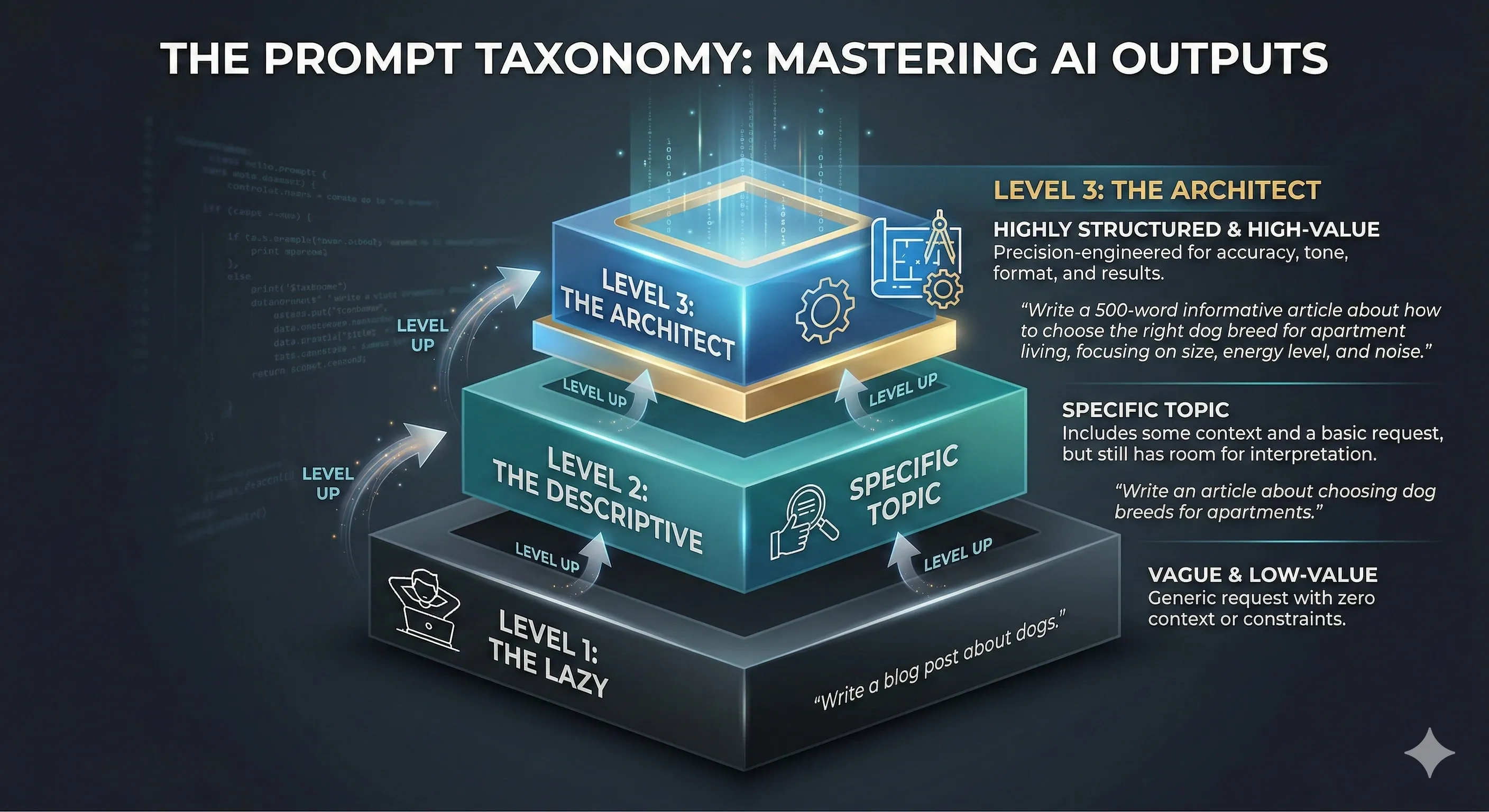
Where do you fall on the scale of AI mastery?
-
Level 1 (The Lazy): “Write a blog post about dogs.”
-
Level 2 (The Descriptive): “Write an article about choosing dog breeds for apartments.”
-
Level 3 (The Architect): “Write a 500-word informative article about how to choose the right dog breed for apartment living, focusing on size, energy level, and noise.”
1. What Makes a Prompt “High-Quality”?
A high-quality prompt isn’t just a “nice” request; it’s a functional instruction set. It must hit these benchmarks:
-
Accuracy: It produces the exact result you envisioned, not just something vaguely related.
-
Efficiency: It minimizes the “I’m sorry, I don’t understand” back-and-forth.
-
Consistency: It works every time you use it.
-
Optimization: It uses the AI’s full capabilities.
-
Time-Saving: It prevents the need for heavy manual editing after the output is generated.
2. The Core Principles of Transformation
To bridge the gap between how we talk and what the AI needs, you must apply these foundational principles.
Principle 1: Extreme Specificity
Vagueness is the mother of hallucinations. If you don’t define the format, the AI will invent one.
-
Weak: “Write something about dogs.”
-
High-Quality: Specify the format (article), the length (500 words), the topic (choosing breeds), the context (apartment living), and the focus (size, energy, noise).
Principle 2: Context and Constraints
The more relevant background you provide, the better the AI can tailor its response.
-
Context: Who is the email for? What is the purpose?
-
Constraints: Keep it under 150 words. Avoid specific jargon.
Principle 3: Explicit Formatting
Don’t make the AI guess if you want a table, a list, or a code block. Tell it.
- Format Options: Numbered lists, step-by-step instructions, CSV, Markdown tables, or professional emails.
Principle 4: Audience Definition
A five-year-old needs a different explanation of blockchain than a venture capitalist.
- Audience Factors: Technical background, age, profession, and specific goals.
Principle 5: Tone and Style Engineering
Set the “vibe” explicitly.
- Styles: Formal, casual, funny, sarcastic, inspirational, or professional but approachable.
3. The Step-by-Step Transformation Process
Follow this five-step engineering process to turn plain English into “God Mode” prompts.
Step 1: The Raw Request
Write down your intent in natural language.
- Example: “I need help with my resume.”
Step 2: The Interrogation
Ask yourself: What specifically do I want? What is the industry? Who is the audience?
Step 3: Layering Detail
Add the context.
- Draft: “Review my resume for a software engineering position at a startup. Focus on my Python experience.”
Step 4: Structure Injection
Tell the AI how to deliver the feedback.
- Refined: “Provide feedback in this format: 1) Strengths, 2) Improvements with before/after examples, 3) ATS keywords.”
Step 5: Style Finalization
Add the personality.
- Final: “Provide friendly, constructive feedback… Be honest but encouraging.”
4. Real-World Transformations: Before and After
Content Creation
-
Before: “Write a blog post.”
-
After: “Write a 1200-word blog post for marketing professionals about the future of AI in content creation. Structure it with five main sections… Use a professional but approachable tone.”
Code Debugging
-
Before: “Fix my code.”
-
After: “Review this Python function sorting dictionaries by date. It’s throwing a TypeError. Explain the ‘why,’ provide the fix with comments, and suggest a more efficient approach.”
5. Common Mistakes to Avoid
-
Information Overload: Giving so much conflicting detail that the AI loses the plot.
-
Conflicting Instructions: Asking for a “brief, comprehensive guide” (pick one).
-
Assuming Context: Expecting the AI to know your industry or personal style without telling it.
-
Micromanagement: Over-specifying to the point where the AI can’t add any value.
-
Failure to Iterate: Walking away after the first result instead of refining the prompt.
6. Advanced Engineering Techniques
Technique 1: Few-Shot Prompting (Examples)
Provide 1-2 examples of the style or format you want. “Write in this style: [paste example]” is the fastest way to get exact results.
Technique 2: Chain-of-Thought
Break complex tasks into a sequence of prompts.
-
- Brainstorm ideas.
-
- Develop a value proposition for the best idea.
-
- Create a framework.
-
- Write the final summary.
Technique 3: Negative Constraints
Define the “No-Fly Zone”.
-
“Don’t use clichés like ‘team player.’”
-
“Don’t use overly formal language.”
7. The Ultimate Transformation Formula
Use this blueprint for every prompt you write:
[Action] + [Specific Subject] + [Context] + [Audience] + [Format] + [Tone] + [Constraints] + [Desired Outcome]
The “Lazy” Way: “Help me plan a trip.”
The “Master” Way: “Create a detailed 5-day itinerary for my first solo trip to Tokyo. I’m interested in authentic food and culture on a moderate budget. Format it as a day-by-day guide with restaurant recommendations, estimated costs, and transportation instructions. Note which reservations should be made in advance.”
The Bottom Line
High-quality prompting isn’t a technical skill; it’s a communication skill. It requires you to be clear, specific, and intentional.
Stop treating the AI like a mind reader. Start treating it like a powerful, literal-minded assistant that needs a clear mission.
Your Mission: Take the last “lazy” prompt you sent. Apply the Ultimate Formula. Run it. Compare the results. Tell me if it didn’t just save you 20 minutes of editing. Go.